Like the title says, enjoy!

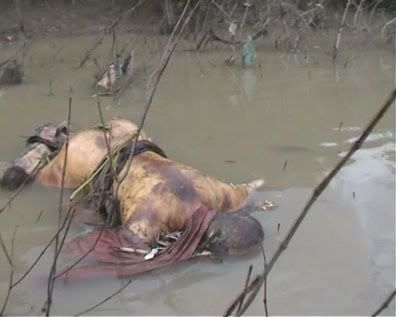
The bloated body of a man lay face down in a shallow muddy pond. His shaven head appears at first glance, to be black; upon closer inspection it becomes apparent that the darkness is actually pooled blood beneath the surface of his papery skin. A massive cross-shaped bruise spans the distance between his shoulder blades, evidence of massive trauma. The only scrape of clothing is a soggy, saffron sash, tangled around his neck like a noose. The body is that of a Burmese Buddhist monk, one of the tens of thousands that started a global movement for a democratic Burma. The monk was murdered by his government in an attempt to squelch an uprising that threatened their power. The international media’s ability to meaningfully explain the circumstances in Burma will determine the world’s emotional reaction and their practical response.
As we shall see, mainstream reports, feel more pressure to be objective, that objectivity makes them sacrifice some of the religious context in favor of shorter, more equitable stories. In fact, we find that the only time a mainstream article gives religion its just due is in larger stories. Outside the most popular American news sources, we find a lack of partiality, but a much more thorough treatment of the religious information or a higher degree of focus on the monks.
Since a coup in 1962, a military dictatorship has ruled Burma. In August 8, 1988, the so called “8888 Uprising” occurred. Large-scale, student-lead demonstrations broke out and the military responded by violently crushing the protests, killing 3,000 people. Nineteen years later, the military junta, to increase their legitimacy, claims to rule in the name of the Buddhist monks, a claim they support in part by providing alms for the monks. The monks live a life free of material objects so they begin each day by walking the streets to beg for food, the military provided some of this food as a way to stay connected with the highly popular clerical establishment.
August 15, 2007, the government removed fuel subsidies in order to make up for a budget deficit caused by their poor decision making. The action resulted in the price of fuel doubling, which, in turn, resulted in a dramatic increase of the price of everyday goods. Political dissidents, outraged over the move, began small scale protests. These protests were disrupted with force, and a small number of individually participating monks were injured by the police.
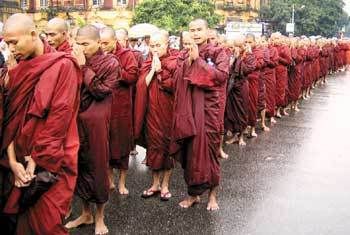
The monks began their protest in retaliation for the violence. Their first action was to turn their begging bowls upside down when offered alms by government agents. In doing so the monks sent a strong signal to the government that they are cut off from the religious establishment. In Burma, the Buddhist monks are members of a faith that 90% of the country share (“Burma”). They are deeply spiritual people and the size of the clerical establishment (300,000) rivals the size of the ruling military (450,000) (Beech). Being cut off from the Buddhist monks is a great humiliation for the government in such a pious nation.
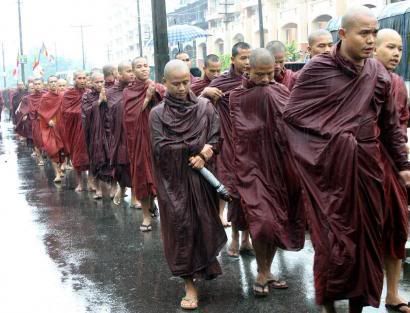
The second action was massive public demonstration. At first it was young monks, before long “all but the most frail joined the street protests” (Montlake). The people then joined the monks and the size of the protests swelled to enormous proportions, “a crowd estimated by the Associated Press to be as large as 100,000 marched […] through the city” (Mydans). The government was humiliated and threatened; their legitimacy was eroding in front of their eyes. The military had to act.
September 26, 2007. “Riot police and soldiers were stationed around pagodas in Rangoon” (Beech), the government also deployed “the […] ‘Lome-Ten,’ a unit of gangsters and ex-convicts, who do the regime’s dirty work” (“They”), and dirty their work was. The peaceful protesters were attacked by armed government agents. They fired into the air to disperse the crowd, and beat monks and other protesters with canes. In the end “at least two monks [were] reported killed” (Beech). The following day, (Sept. 27) the violence escalated, “soldiers reportedly fired into crows and beat Buddhist monks […] state media said nine people were killed” (“Nine”). There were eye-witness reports of a protestor being beaten to death, another being indiscriminately shot, and the death of a Japanese photographer (“Nine”). The government preceded this attack with midnight raids on villages and monasteries thought to be anti-government. In one report, government soldiers surrounded a monastery in Rangoon, ordered all 200 of the monks outside where they were beaten and kidnapped (“They”). It appears that many of the captured monks and protesters are being processed at three central detainment facilities in Rangoon, including nearly 800 monks who are being held in egregious conditions at the institute of technology (“They”). Another report echoed these accusations, “at least 1,000 forcibly disrobed monks are reportedly being detained in Army and police camps and in converted school buildings” (Montlake). The remainder of the monks fled back to their home or across the border to neighboring countries, with only the very old staying behind in the monasteries (Montlake). Casualties and the whereabouts of many monks are unknown.
Five articles were chosen that reported on events leading up to, and following the crackdown. Three “mainstream” sources were chosen, CNN, The New York Times (NYT), and Time Magazine. Two additional sources, outside the American mainstream were consulted, The Christian Science Monitor (CSM) and The Spiegel Online. These articles reflect the range of coverage of the incident and will provide evidence to draw conclusions about the way media covers news with religious elements.
CNN.com posted an article reporting the initial violence of the Burmese crackdown. The piece, true to its main stream roots, treated the religious elements of the story and the actors within it with a tremendous amount of journalistic objectivity. A highly difficult and probably artificial feat, given the one-sidedness of this conflict. The monks were equal to the Regime in representation and tone. The actions of both, to be judged by the reader, were presented fairly, but the article gave too much credence to the junta. For example, the title of the article, “Nine Reported Dead in Myanmar Crackdown” is actually the official body count of the regime. The article goes on to give evidence that the violence is almost certainly more severe. They mention the deaths of at least three individuals, one shot by soldiers, another beaten to death, and the foreign photojournalist who was killed. Given the limited scope of CNN’s coverage, surely it can be extrapolated that the government’s figures are woefully inadequate or at least suspect, a criticism not found in the article. Hence, the credibility they give the repressive military dictatorship is undeserved and slightly insulting. Indeed, because news articles are often remembered solely as their headlines, this article gives the impression that the violence is more minor than it is. In addition the article failed to place the monks in their proper context within Burmese society. CNN’s story was the shortest of the bunch, but what they made up in brevity they lost in content that would help the reader to better understand the monk’s actions. In fact, almost nothing is said to explain the unique nature of the movement given the unique role of the monks in the culture. It seems as though when brevity is required, the first thing to go is religious content.
The NYT published an article before the crackdown occurred. The article covered the update with the journalistic objectivity typical to mainstream media. Like the CNN article, all the actors were given equal treatment and disclosure. Unlike the CNN article, the NYT tried to explain some of the religious elements of the story. The article expressed the religiosity of Burma, and gives the monks credit for enlarging the protests to their newsworthy levels. While The Times could have included much more religious context, they covered it better than CNN. They gave only a fraction of the space to the religious elements, and focused mostly on international concern and the political history of Burma. This article was medium length, and the pattern that is emerging is that mainstream outlets save space by omitting the religious details of the story. However, when given ample space, the religious elements of the story can be more fully expressed.
The Time piece was written during the crackdown, and is about twice as long as any of the other articles. The author, Hannah Beech, uses that size to update the reader about the most breaking news and to explain the religious elements that make the monk’s story so compelling. The article covers the religious context comprehensively and accurately. In fact, the article’s entire focus is on the monks and their role. Perhaps comprehension requires partiality, because the Time article is absolutely in favor of the monks. The journalistic integrity espoused by Beech’s colleagues at CNN or the NYT is gone, replaced with a noticeable bias in favor of the monks. Of course, the bias is natural and rational. With this story, it is extraordinarily difficult to treat the despotic and violent actions of a repressive regime as equal to the peaceful and reasonable actions of holy men.
The CSM article focused exclusively on the monks. It was written shortly after the crackdown began. Monks, fleeing the violence, began to cross the boarder into Thailand where they were interviewed by Simon Montlake, a CSM reporter. The interviews are used as a centerpiece to tell the story of how the protests came about, and why the monk’s actions, in Burmese culture, are so revolutionary. The religious context is not only fully expressed, but also expressed in the monk’s favor. The monks are so focused on, that there is little information about any other actor in this political drama. The regime and civilian protesters are neglected, and the monks’ role is taken to be central. Given the religious nature of the news reporting agency, this shouldn’t be surprising. Their focus allows the entirety of the monks’ role to be brought to life.
The Spiegel Online posted a highly partial and monk focused article in the days following the crackdown. It describes the violent tactics used be the government against the monks. The Spiegel piece called members of the government’s military “gangsters” and “henchmen”, not exactly an impartial interpretation of security forces. The focus on the monks, however, did not guarantee them accurate religious coverage. The article lacked much of the religious context that gives the monk’s protests their importance. The article does not credit the monks for enlarging the protests, it doesn’t describe the scope and influence of the clerical establishment, nor does the article discuss the cultural importance of rejecting military alms. But the focus on the monks and their fate represents a focus on the religious import of the story.
Clearly mainstream American sources are under constraints that their less mainstream or foreign competitors are not. CNN and the NYT devoted more actual coverage and more preferential coverage to the regime, than did The Christian Science Monitor or The Spiegel, which both focused on the monks. Time magazine, with its focus on the monks and its complete explanations of the religious context provides the best coverage of the story. CNN’s article was by far the worst. It was too short, too devoid of information and it gave the military too much credence in their reporting.
.jpg)